
Atrial fibrillation can develop silently, without any obvious symptoms, yet it poses a real health threat. This insidious condition affects tens of millions of people globally, with the number of diagnosed cases steadily increasing. Early detection of irregular heartbeat could prevent many complications, but traditional methods require regular checkups with a specialist. However, an unexpected ally in this fight is emerging. It turns out that devices many of us wear daily – smartwatches – can provide valuable information about the health of our hearts. Can wearable technology actually compete with professional medical equipment?
Smartwatches for atrial fibrillation diagnosis. Accuracy reaches 95%.
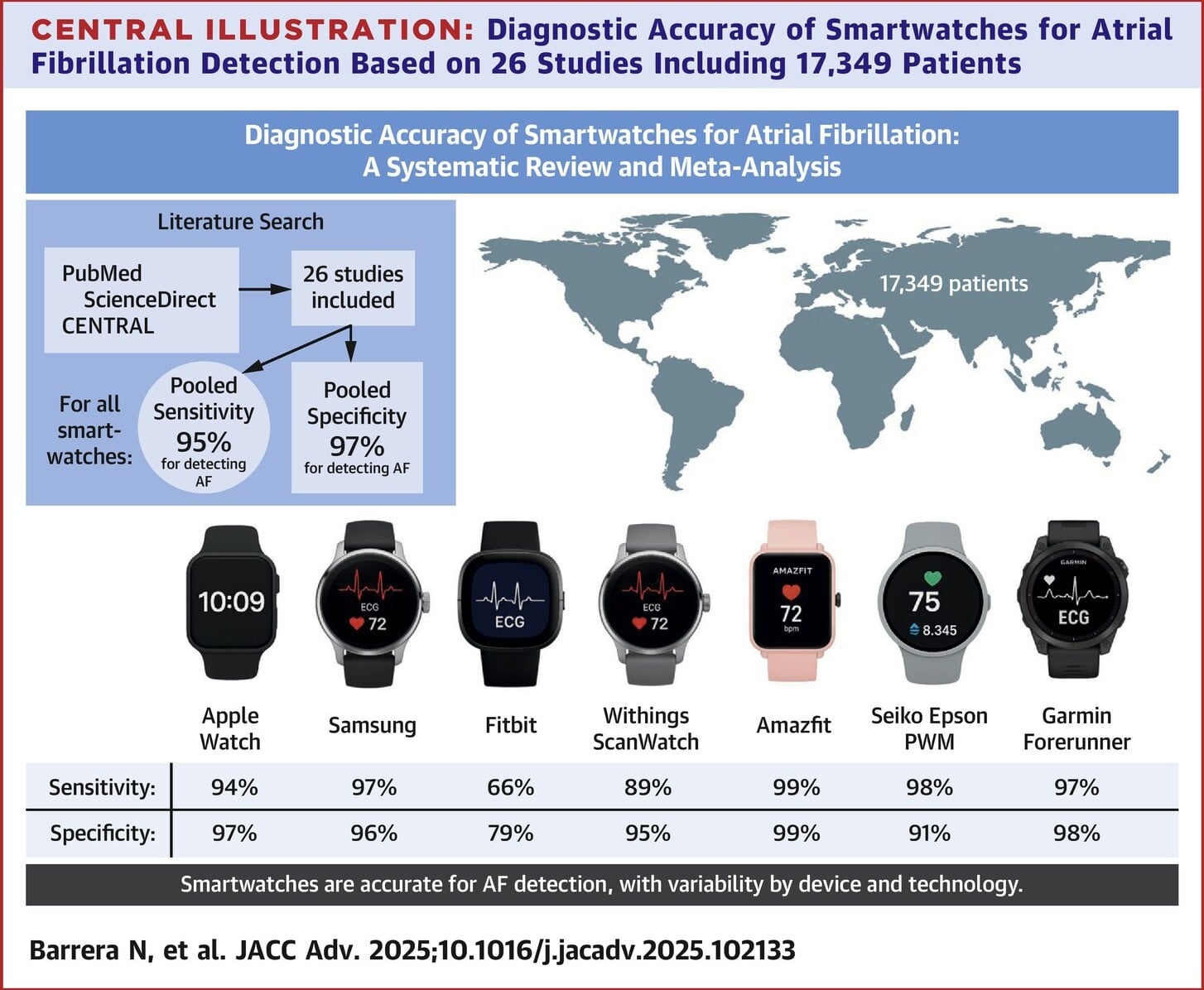
The groundbreaking data comes from a large-scale meta-analysis of 26 clinical trials , covering a total of over 17,000 patients. The results are surprisingly good – the devices achieved a sensitivity of 95% in detecting atrial fibrillation, with a specificity of 97%. The area under the ROC curve was 0.97, which in practice means that smartwatches perform exceptionally well in this task.
Interestingly, both photoplethysmography (PPG) and electrocardiogram (ECG) devices demonstrate similar effectiveness. PPG analyzes changes in blood flow using light, while ECG records the electrical activity of the heart muscle. The fact that the simpler optical technology performs equally well opens up interesting possibilities for widespread screening. Many of these devices already have the necessary certifications, including US FDA approval and the European CE mark. The Apple Watch first received approval for the ECG function in 2018, marking a new chapter in the development of wearable technology.
The results across brands proved quite varied.
The Samsung Galaxy Watch achieved the highest diagnostic parameters with an area under the curve of 0.98, a sensitivity of 97%, and a specificity of 96%. Amazfit came in close behind with 98.68% sensitivity and 98.87% specificity. The Apple Watch, despite being a pioneer in this field, took third place with 94% sensitivity and 97% specificity. The Withings Scan Watch demonstrated 89% sensitivity with 95% specificity, while the Garmin Forerunner 945 achieved 96.97% sensitivity but only 88.24% specificity. The Seiko Epson Smartwatch achieved 98.04% sensitivity with 90.64% specificity. Fitbit recorded the poorest results with just 66% sensitivity and 79% specificity. This clearly demonstrates that advertised functionality alone doesn’t always translate into actual diagnostic value.
The analysis revealed an interesting pattern – the larger the study group, the better the device effectiveness parameters.
This likely stems from the more rigorous methodology and more precise statistical calculations used in larger research projects. Importantly, after taking into account sample size, differences between individual brands and measurement technologies were no longer statistically significant. This suggests that earlier reports of clear advantages for specific manufacturers may have been due to the limitations of smaller studies rather than to a true difference in quality.
Nevertheless, significant discrepancies in results were observed between individual research projects, which indicates the influence of specific methodologies and characteristics of the studied groups.
Even though technology is advancing, it is still not infallible.
The problem of false alarms remains a challenge , which can lead to unnecessary anxiety and doctor visits. On the other hand, it’s better to have a false alarm than to miss a real problem. Another important caveat is that the study groups had a higher prevalence of atrial fibrillation than the general population. In practice, this may mean that in everyday use, the positive predictive value will be lower and the negative predictive value higher than the study results indicate.
The question of the degree of subclinical atrial fibrillation that actually requires medical intervention also remains unresolved. Some studies excluded patients due to poor recording quality, suggesting that errors may occur more frequently in real-world settings.
Background information on the results
Some background information may be needed for interpretation and classification, along with an explanation of technical terms. In a medical-diagnostic context, sensitivity specifically indicates how many diseases or “abnormalities” are detected, while specificity indicates how many healthy individuals are correctly identified as healthy. As described in analysis of the Apple Watch’s blood pressure function, these two values are related. Diagnostic procedures can be optimized for higher sensitivity or specificity within certain limits, provided that the procedure is generally suitable. In a screening procedure such as the detection of atrial fibrillation, high sensitivity should be clearly prioritized over high specificity, at least from the individual patient’s perspective. While a false-positive result might lead to wasted waiting time at the doctor’s office and an unnecessary ECG, this is, of course, a far better alternative to the increased risk of mortality associated with undetected atrial fibrillation.
Background information on the study
The study is a systematic review, meaning that Barrera N et al. did not take any measurements themselves, but rather reviewed existing studies and included them in the evaluation (or not). The advantages of such studies are that the number of cumulative participants is very high and the number of different brands/devices tested is greater. At this point, we would like to clearly point out that this review cumulates different, specific model variants from individual manufacturers and that the number of test subjects per specific device varies greatly in some cases. Furthermore, the measurement methods used in the individual studies are not always the same. The study by Barrera N et al. is currently still in the preprint stage and so has not yet been peer-reviewed. Lastly, the research landscape may still change if, for example, new devices come onto the market.

Leave a Reply